
Curved Treadmill vs Motorized Treadmill: What Changes?
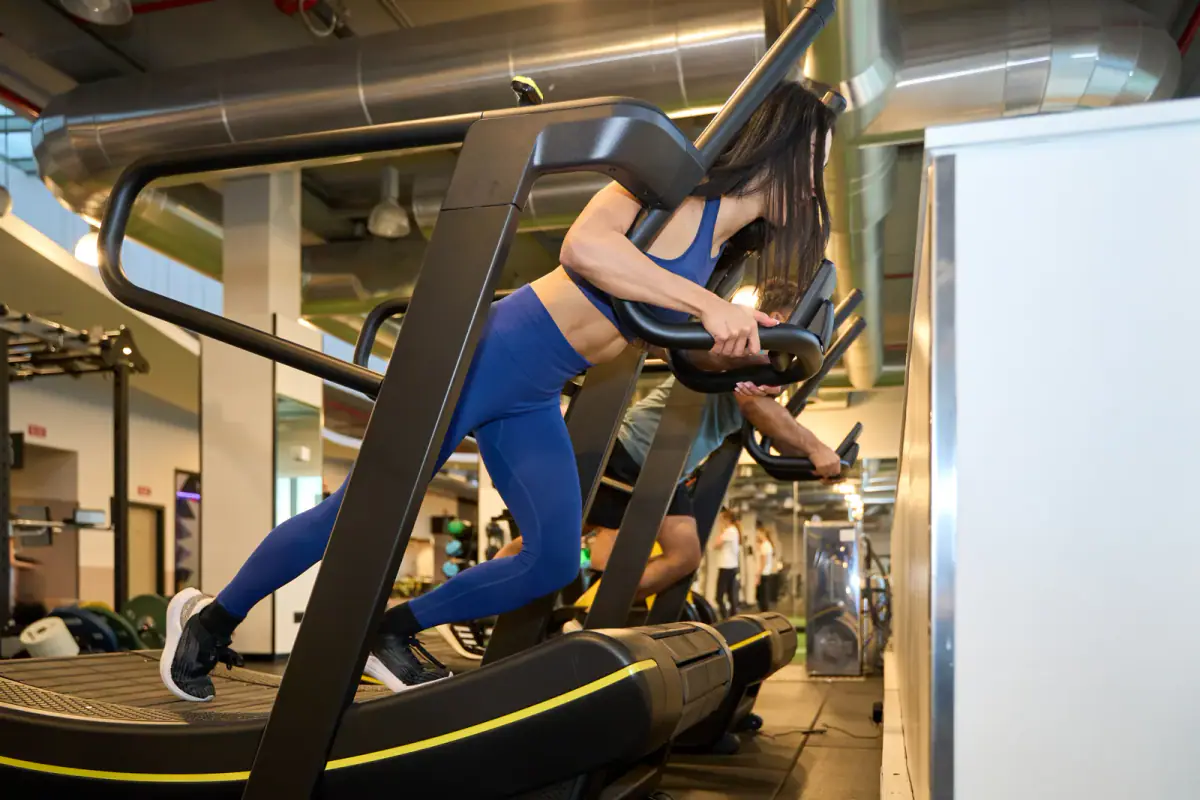
A curved treadmill runs without a motor, so you move the belt with your own effort, while a motorized treadmill spins the belt at a speed you set. That one difference changes the pace, the effort and the feel of your stride, and it is why runners who like one often dislike the other. You can try the curved one in a private cardio room by the hour, and neither type is better in the abstract. It depends on what you want to train.
How each machine works
A motorized treadmill has an electric motor that drives a flat belt at the speed you choose. You can set a precise pace, change the incline and stop the belt instantly with a button. It keeps you to a number.
A curved treadmill has a curved deck and a belt that moves only when you push it. There is no speed setting: the faster you drive your feet, the faster the belt goes, and when you stop, the belt slows. You set the pace by effort. FlexWerk’s cardio rooms carry curved treadmills.
What changes when you run on one
| Motorized | Curved | |
|---|---|---|
| Who sets the pace | The console | You |
| Precise speed target | Easy | Hard |
| Incline | Adjustable | Usually fixed by the curve |
| Effort at the same speed | Baseline | Typically higher |
| Stride | Natural, rolling | Often more forefoot, upright |
| Stopping | Button or decelerate | Slow down yourself |
Because you have to drive the belt, a speed that feels gentle on a motor can feel hard here, so people often find their usual pace is slower than they expected and the effort is higher. That is sometimes described as a better match for interval work, since the belt follows your effort up and down. Calorie claims for either machine vary widely, so use effort and heart rate rather than a console number.
Joints and stride
A curved belt usually encourages an upright posture and a quicker, lighter step, and many people find it forgiving. Others notice more load in the calves and Achilles area, especially early on. A motorized machine, on the other hand, carries you forward at the belt speed, which is gentler on a day you want a steady easy run. If an ankle, knee or hip is bothering you, ask your clinician before switching surfaces, and build the time gradually.
Which one to try
- If you like exact paces and planned tempo work, a motorized treadmill fits.
- If you like intervals and effort-based running, try a curved one.
- If you are rebuilding after time away, begin with the motorized machine and walk.
- If you are curious, try both types; the cardio rooms here offer the curved one, so you would compare it with a motorized machine you already know.
Because treadmills are a big purchase, trying premium cardio by the hour explains how to test one before buying. In a private workout space cardio room, you can try the curved treadmill alone, with no one watching your first awkward minutes, from $12 an hour. If you want to see your own stride, filming your running form on a treadmill shows how to set up the shot. And for a different kind of effort, a vertical climber compared with a stair climber covers the climbing side.
A host can book your first hour at (888) 353-9975; anyone 18 or older and local to Carmel can ask about the free first hour.
Related questions
Is a curved treadmill harder?
Usually, at the same speed. You power the belt yourself, so a pace that feels easy on a motorized machine can feel demanding on a curved one. Start shorter than you think you need to.
Is it easier on the joints?
Some people find the self-paced stride more forgiving, others feel it in their calves and hips. Individual responses vary, and anyone with joint concerns should check with a clinician first.
Can I film my stride on one?
Yes. A cardio room has space for a phone on a stand, and filming your form on a curved belt is covered in a separate answer.